Saturday, July 21, 2012

il DICIANNOVE di luglio

Costa S. Giorgio, no. 19
La casa di Galileo Galilei

Ok, I fell behind posting because this one was across town and up a steep hill and I knew that I had to wait until I had a free (cooler) morning to walk over there.


Most of Galileo is buried here, in Santa Croce.


But a few fingers and a tooth are here, in the museum dedicated to the history of science:


When he died he wasn't allowed to be buried in a sanctified cemetery, but 100 years later, after overwhelming evidence supported his views, his body was moved. A science historian who was at the burial ceremony, however, couldn't resist cutting off parts of the scientific genius and keeping them for himself.

Friday, July 20, 2012

il DICIOTTO di luglio

Eighteen Medici balls

Everywhere you go in town you are faced with the Medici balls. Here are just three examples.

In the Convent of San Marco. Pretend there are six balls -- it's too hot to go out and find another set of six.


Thanks. In exchange for pretending there were six balls, I'll let you see the pretty cloister:


At the Medici Chapel:


In Ss. Annunziata:


Tuesday, July 17, 2012

il DICIASSETTE di luglio

via dei Servi, no. 17
Casa di Massaccio


Massaccio's (1401-1428) most famous work is the Brancacci Chapel. Fun facts from Wikipedia: "Masaccio's application of scientific perspective, unified lighting, use of chiaroscuro and skill in rendering the figures naturalistically established new traditions in Renaissance Florence that some scholars credit with helping to found the new Renaissance style. The young Michelangelo was one of the many artists who received his artistic training by copying Masaccio's work in the chapel. The chapel was also the site of an assault on Michelangelo by rival sculptor Pietro Torrigano, who resented Michelangelo's critical remarks about his draughtsmanship. He punched the artist so severely that he 'crushed his nose like a biscuit' (according to Benvenuto Cellini), which deformed Michelangelo's face into that of a boxer's."


It's easy to miss as the entrance is right next to one of the most nondescript churches in town, Santa Maria del Carmine.


Monday, July 16, 2012

il SEDICI di luglio

via Ricasoli, no. 16


 I took this picture wondering what could have happened over the years beyond this gate.


When I turned the corner, I realized that it was the headquarters for the great designer Emilio Pucci. The Pucci family is from Florence and, therefore, keeps the main office here rather than in Milan. All of the small windows above the balcony are all trompe l'oeil.


I couldn't understand all the African images on the building, but it appears that since Renaissance times the Puccis have had Africans in their coat of arms.  Who knew?


ll QUINDICI di luglio

via Guicciardini, no. 15
La casa di Francesco Guicciardini.


Guicciardini was a Renaissance historian, one of the first to use government documents to support his arguments. For historians who have ever logged in hours in the archives, you have Guicciardini to thank.


Based on these quotes, I guess it's not surprising that Guicciardini was at times a friend and critic of Machiavelli. In fact, I read somewhere that Machiavelli lived next door for a while. 

"One who imitates what is bad always goes beyond his model; while one who imitates what is good always comes up short of it." --Francesco Guicciardini

"Since there is nothing so well worth having as friends, never lose a chance to make them." --Francesco Guicciardini 

via dei Bentaccordi, no. 15

La casa di Michelangelo Buonarroti.


You might have heard of Michelangelo. He is the inspiration behind this and other more classy examples:


Just to be fair, a few quotes from Mike B:


"Faith in oneself is the best and safest course."  
"I am a poor man and of little worth, who is laboring in that art that God has given me in order to extend my life as long as possible."
"I am still learning."
"I have never felt salvation in nature. I love cities above all."
"I hope that I may always desire more than I can accomplish."
"I live and love in God's peculiar light."  

Saturday, July 14, 2012

il QUATTORDICI di Luglio

Piazza Strozzi, no. 14

The oh-so-imposing Palazzo Strozzi.


The Strozzi family may have had the same amount of money as the Medici, but never their power. The interior courtyard:


Friday, July 13, 2012

il TREDICI di luglio

via Porta Rossa, no. 13


Palazzo Davanzati. I was a good citizen and didn't take pictures inside the medieval merchant family's home, but you can have an idea of the elaborately decorated space here.

il DODICI di luglio

Borgo Ognissanti, no. 12
The Reversed Balcony


Information from lifeinitaly.com: "The building goes back to the 16th century and it seems to have been built by the owner of the house out of spite with the Duke Alessandro de' Medici. The initial project of the balcony was rejected by the Duke as, for some law of the time, it was too prominent. The owner of the building presented a second project, with little changes, and even this time it was rejected. At the third attempt, the Duke, trying to be irreverent or just fed up with the continuous requests, wrote on his response: " Yes, on the contrary". The owner of the house, expressing a true Florentine spirit and applying the answer to the letter, ordered his architect to build the balcony upside-down."


If you look closely, you'll see that all the corbels, pediments, capitals, etc. are upside down.


Wednesday, July 11, 2012

l'UNDICI di luglio

via Lungarno Torrigiani, no. 11

After the Russian church, it seems only fair to show the Lutheran one:


Tuesday, July 10, 2012

il DIECI di luglio

Piazza della Santissima Annunziata, no. 10

This wonderfully harmonious Renaissance piazza is famous for the Hospital of the Innocents (the first orphanage in Europe) designed by none other than Brunelleschi (architect of the cupola). I just heard that the balanced set of buildings on one side of the square and the other were meant to reflect the balanced books much prized by the Florentine bankers who bankrolled the buildings.


This is the famous revolving cradle where mothers could leave their babies. They could pull on a bell chord and walk away. Then, the nuns would turn this human Lazy Susan and take the babies into the orphanage. The Renaissance version of the Safe Haven law.


Ferdinando I (a Medici, of course) with a pigeon hat. It appears that Ferdinando was a pretty fair ruler, even though there is a good chance that he had his brother and sister-in-law poisoned ... but that's pretty run-of-the-mill for the Medici.


I walk through this square every day on my way to work.

il NOVE di luglio

Piazza della Signoria, no. 9
Museo Gucci

It just opened in September and allows fashion lovers to learn more about the famiglia Gucci and their products. I didn't feel that it was worth the 6 Euro entrance fee, but then I'm not known for my love of fashion. There is also the Ferragamo museum, if you want to see the Ferragamo shoes that Audrey Hepburn, Marilyn Monroe and others wore.


The best part of the museum is probably the view from the front door.


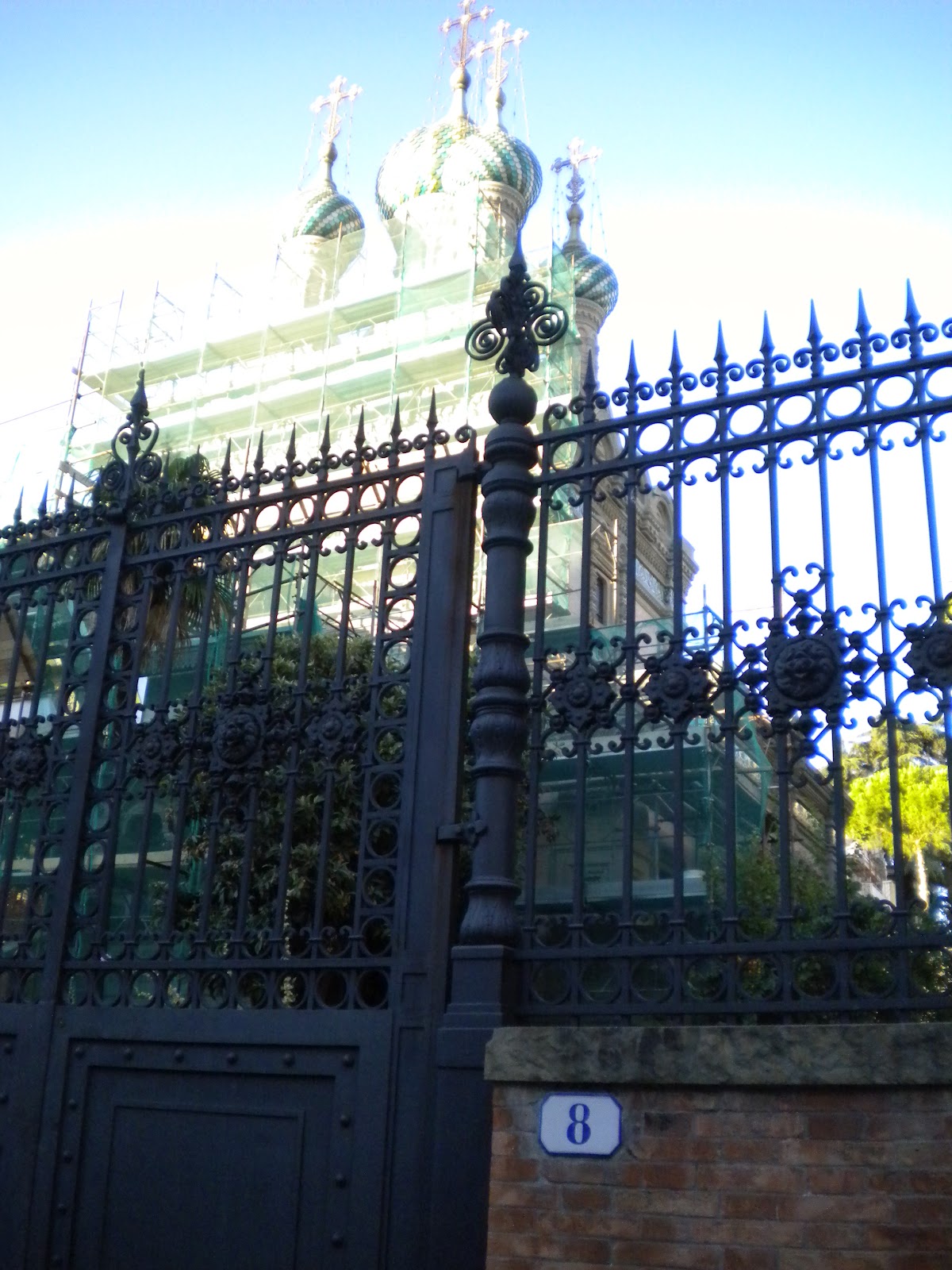
l'OTTO di luglio

via Leone, no. 8


I've been to Florence 8 times now, and I had never seen this Russian church before. It looks similar to and was built about the same time as the Russian church in San Remo. Little did the nobles know that they only had about 15 years of the high life left when they built this beauty.


il SETTE di luglio

via della Condotta, no. 7
una pizzeria


Seven had me blocked. There would be interesting places at 3, 5, and 9, but then nothing at 7. Or the numbers would simply skip seven. It was between this--a representative pizzeria--or a church called Sette Santi (Seven Saints) or a storefront to represent that the big summer sales started on 7/7.

il SEI di luglio

Il loggiato degli Uffizi, no. 6
Just part of the line waiting to get into the Uffizi.


via del Corso, no. 6
Beatrice Portinari's former house. 


Dante may have been walking down this very street the first time he saw her. (These plaques all mark places or people who are mentioned in the Divine Comedy. And when you read about a woman in a red dress, it can only be Beatrice.)


Saturday, July 7, 2012

il CINQUE di luglio

Binario no. 5, Campo di Marte train station


How many hours of my life have I spent anxiously awaiting a train on a hot, hot train platform?

Wednesday, July 4, 2012

il QUATTRO di luglio

Il Bargello, via del Proconsolo, 4

The Bargello is Italy's most important museum dedicated to sculpture. Originally, it was the seat of the mayor, later the police captain and city prison. Like a dress that sometimes outshines its wearer, the Bargello often seems to be more beautiful than its contents. What do you think?


Sorry, that's not fair! I couldn't show you pictures of the sculptures, the most famous of which is Donatello's David, which are inside.

Last night my landlord, a composer of electronic music, left me a ticket for a modern dance performance which they held inside the courtyard of the Bargello. A magical place for a performance. And they were clever with projecting images and videos on the wall (for example, giant ants climbing the stairs).


Tuesday, July 3, 2012

il TRE di luglio

Palazzo Medici-Riccardi, via Cavour, 3


This little jewel is home to the famous Procession of the Magi fresco by Benozzo Gozzoli. Whatever the entrance fee, it is worth it to see it up close. You may have seen parts of this fresco in books or on calendars or on hanging banners, but it is completely different in person. First of all, standing in the tiny room, you realize -- again...as if it doesn't get hammered into you enough when you are in Florence -- just how powerful and wealthy the Medici were to be able to commission such a piece (and how powerful and wealthy and arrogant they were to have family members inserted into the Biblical scene). The impact of being surrounded by such vivid colors can't possibly be replicated in a book.

See? The banner doesn't do it justice. (The shadows don't help, either.)


Pull up your horse and stay awhile.


Monday, July 2, 2012

il DUE di luglio

via del Campanile, 2


GROM. There are a few gelaterie which vie for best in the city, and GROM is one of them. A few years ago I went to a talk at GROM about how to make gelato. There I learned a very important fact: gelato has fewer calories than ice cream. Enjoyment without a guilty conscience.  Double the pleasure.


I walked all around this building at via Pier Antonio Micheli, 2, but I couldn't figure out what it was. All of this turn-of-the-century goodness has to have some purpose, doesn't it?